How a Trade Works
A Darwin trade from QoreX is one signature: you sign plain text in QoreX, and your Darwin account checks it on chain before it trades. No EVM window, no authz grant, no gas for the trade. The first buy also asks you to approve one fUSD deposit. Developer detail is on Buying, Selling and Darwin Accounts.
Why an account and a relayer
QoreX shows its user every message it signs, decoded, and refuses what it cannot display. Darwin established, message type by message type, what the extension accepts today:
| Message | QoreX |
|---|---|
Bank send (MsgSend) | shown and signed |
Authz grant (MsgGrant) | shown and signed, with its expiry |
CosmWasm call (MsgExecuteContract) | shown and signed |
Message signature (signArbitrary) | shown and signed |
Cross-VM call (MsgCrossVMCall) | refused |
ERC-20 conversions (MsgConvertCoin, MsgConvertERC20) | refused |
Darwin's baskets are EVM contracts, and QoreX cannot send an EVM transaction. So each QoreX user gets a DarwinAccount: a contract controlled only by the ML-DSA-87 key the user registered on QoreChain. You sign a message; Darwin's relayer submits it and pays the gas; the account checks your signature with pqcVerify and only then calls the router. See Darwin Accounts.
Your account
- Its address is fixed by your own address (CREATE2), so it is known before it exists. It is created with your first trade.
- Only an account whose ML-DSA-87 key is registered with proof of possession gets one. QoreX registers it with your first transaction.
- It can call only Darwin's router, the four baskets and fUSD.
- It holds your fUSD and your basket shares.
Buying, step by step
0. The deposit, when needed
Faucet fUSD sits in your QoreX wallet as a bank coin. If a buy needs more fUSD than your account holds, the app first asks QoreX to sign one MsgSend of the difference to Darwin's relayer. The relayer checks that transaction and converts exactly that amount onto your account in ERC-20 form (MsgConvertCoin, receiver = your account). Each deposit is credited once. It costs a little QOR in gas.
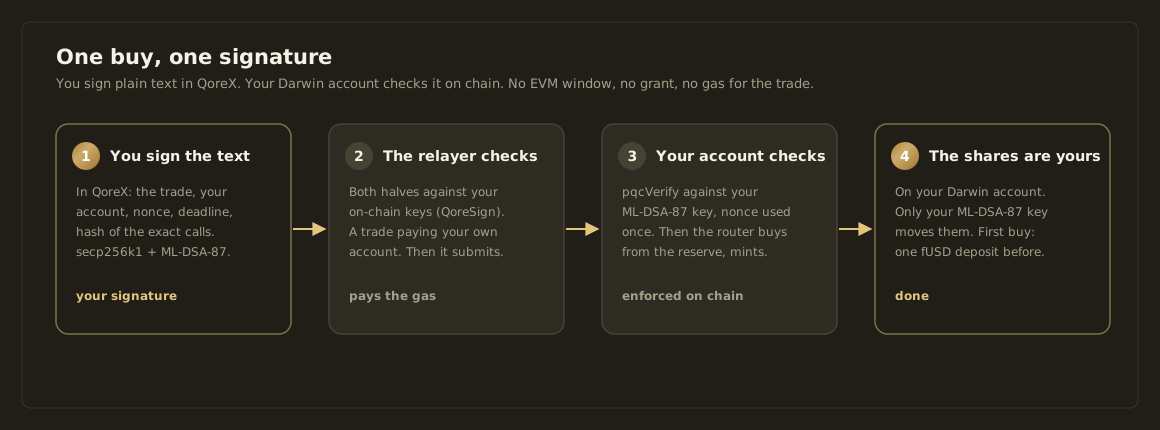
1. You sign the text
The app builds a short text and QoreX signs it with signArbitrary: an ADR-36 secp256k1 signature and an ML-DSA-87 signature over those exact bytes.
Darwin: Buy 10.00 fUSD of BLUEdw, for at least 1.035000 BLUEdw

Darwin account 0x…
nonce 4
valid until 1795190400
calls 0x…
The last line is the hash of the exact calls: an fUSD approval of the router if needed, then router.buy(basket, 10 fUSD, minShares, your account). The message is valid for 10 minutes.
2. The relayer checks it
The relayer (app/src/server/accounts.ts) verifies both halves with QoreSign's verifyMessageWithChain against the keys your account registered on chain, and checks that the calls are a trade paying your account. Then it submits factory.execute(owner, calls, summary, deadline, pqSignature) and pays the gas. The transaction is a MsgCrossVMCall the relayer hybrid-signs (secp256k1 + ML-DSA-87), so the chain verifies it too. Every transaction Darwin sends, rounds and rebalances included, goes out this way; none of Darwin's accounts holds an EVM window.
3. Your account checks it on chain
The account rebuilds the text, prefixes it with qorechain-msg-v1|qorechain-diana| as QoreX did, and verifies your ML-DSA-87 signature with pqcVerify against the key pqcKeyStatus returns. It moves its nonce, checks every target against Darwin's list, then calls the router. The router takes the 0.30% fee, buys each component from the reserve at oracle prices, and the basket mints the shares to your account.
4. The shares are yours
They are an ERC-20 balance on your account. Only a message signed by your ML-DSA-87 key moves them.
Selling
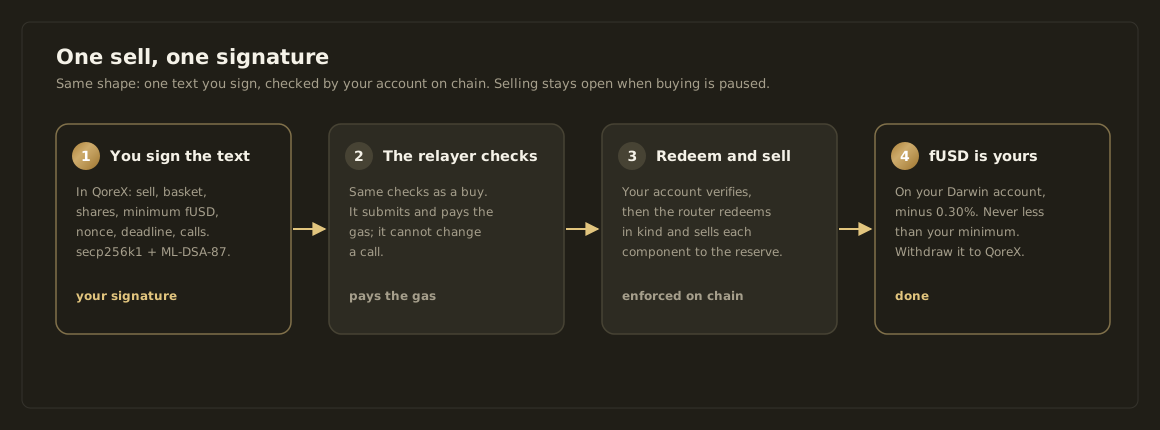
Same shape: one text you sign, for router.sell(basket, shares, minUsd, your account). fUSD lands on your account.
Withdrawing
Portfolio's Cash row has Withdraw X fUSD to QoreX: one signed message. Your account transfers the fUSD to the relayer, which returns it to your QoreX wallet in bank form (MsgConvertERC20, receiver = you). If the two steps are cut apart, the relayer completes the second before the next withdrawal and in its daily run.
What each actor can and cannot do
| Actor | Can | Cannot |
|---|---|---|
| You | Sign trades and withdrawals; deposit fUSD | Mint shares without paying for the components |
| The relayer | Submit your signed messages and pay the gas; refuse or delay them; hold fUSD for one transaction during a deposit or withdrawal | Change a call, replay a message, make your account call a contract outside Darwin, or move anything you did not sign |
| The reporter (oracle key) | Sign price rounds | Move a price more than 15% in one round, or publish rounds less than 60 s apart |
| The curator | Sign target weights and rebalance trades | Trade components that are not in the basket; lose more than 1% of NAV in a rebalance |
| The admin | Sign the 16 admin actions; change the accounts' allowed targets | Act with a secp256k1 key alone |
| The guardian | Pause new mints, with a hybrid-signed transaction | Unpause, rebalance, or block selling and redeeming; pause with a secp256k1 key alone |
Where the trust sits
Stated plainly.
- Deposits and withdrawals. Your fUSD passes through the relayer for one transaction each way: a custody of seconds. Trades themselves are enforced by your account, not by the relayer.
- Liveness. If the relayer stops, trades from QoreX stop. Your holdings stay on your account, and the account accepts your signed messages from any submitter.
- The oracle's inputs. Signatures prove who published a price, not that the price is right. QOR comes from its market (CoinGecko and MEXC), QWAKK from its only pool. See Oracle.
Shares bought before DarwinAccounts
They sit on your EVM twin. Selling them takes the original path: an EVM window opened in QoreX, a 24-hour grant to the relayer, then a signed intent the relayer executes through authz MsgExec. The trade card guides it. See QoreX & the Relayer.
Risks covers the rest.