Overview
One token for a whole portfolio, where every price, every rebalance, every admin action and every trade is authorised by a post-quantum signature.
Darwin is a basket protocol already live on Miden mainnet. Darwin on QoreChain is its post-quantum port, running on the qorechain-diana testnet. You pay fUSD and receive one basket token; the basket contract holds the components behind it. You exit by selling the basket token for fUSD.
The problem
Owning a theme means owning several assets at once. By hand, that is one swap per leg and a rebalance every time the weights drift. A basket protocol solves that, and concentrates the risk in three keys: the one that sets prices, the one that trades the vault, and the one that administers it.
On Q-Day, a quantum computer derives a secp256k1 private key from its public key. Every key of that kind that ever signed on chain becomes a key anyone can use. A basket protocol whose oracle, curator and admin are classical keys can then be repriced, rebalanced into nothing, or drained.
Darwin on QoreChain puts all three behind ML-DSA-87 (FIPS 204), verified on chain by QoreChain's precompiles against keys registered with proof of possession. No secp256k1 key alone can change a price, a weight, a trade or a parameter, or move the reserve's funds.
The baskets live today
| Basket | Token | Holds | Target weights |
|---|---|---|---|
| Darwin Blue Chip | BLUEdw | fBTC, fETH | 70 / 30 |
| Darwin Balanced | BALdw | fBTC, fETH, fUSD | 35 / 35 / 30 |
| Darwin Qore Ecosystem | QOREdw | fQOR, fETH, fQWAKK | 60 / 25 / 15 |
| Darwin Degen | DEGENdw | fQOR, fQWAKK | 30 / 70 |
fBTC, fETH and fUSD are the fest's test tokens for BTC, ETH and dollars. fQOR and fQWAKK are Darwin's stand-ins for QOR and QWAKK, priced by the same feeds. See Baskets and why stand-ins.
Architecture in one picture
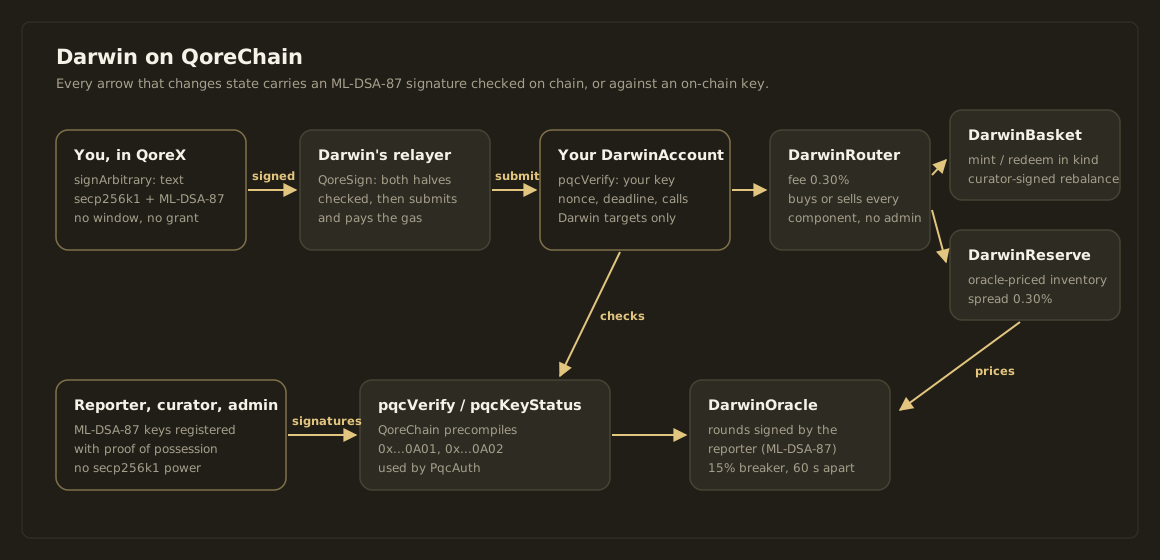
The six parts
-
The basket. One ERC-20 contract per basket (
DarwinBasket). It holds its components, mints shares against components in kind, redeems shares into components in kind, and rebalances only with trades the curator signed. See Baskets. -
The reserve.
DarwinReservesells and buys components at the oracle's prices, minus a spread. The EVM cannot call QoreChain's native AMM, so a basket buys from the reserve's inventory instead. See NAV & Pricing. -
The router.
DarwinRouterturns fUSD into a whole basket in one call (buy), or a whole basket back into fUSD (sell). It holds nothing between transactions and has no admin. -
The oracle.
DarwinOraclestores prices only from rounds signed by the reporter's ML-DSA-87 key, with a 15% circuit breaker and rounds at least 60 seconds apart. See Oracle. -
Your Darwin account and the relayer. QoreX, QoreChain's wallet, does not send EVM transactions. Each QoreX user gets a Darwin account, a contract controlled only by the user's registered ML-DSA-87 key. The user signs a trade as text; Darwin's relayer submits it and pays the gas; the account checks the signature with
pqcVerifybefore it trades. No EVM window, no grant. See Darwin Accounts. -
Your wallet. QoreX, with your secp256k1 and ML-DSA-87 keys. Your basket tokens sit on your Darwin account; only your ML-DSA-87 key moves them.
What the chain enforces, and what Darwin's services do
| Property | Enforced by |
|---|---|
| A price is stored only if the reporter's ML-DSA-87 signature over it verifies | DarwinOracle.submit through pqcVerify (0x...0A01) against the key pqcKeyStatus (0x...0A02) returns |
| A rebalance executes exactly the trades the curator signed, and loses at most 1% of NAV at oracle prices | DarwinBasket.rebalance |
| Every admin power (16 functions, including moving the reserve's funds) needs the admin's ML-DSA-87 signature | PqcAdmin: no function checks msg.sender for admin powers |
| A basket's shares are always backed in kind, and redeeming in kind needs no price, no curator and no admin | DarwinBasket.redeem |
| Your trade is the one you signed | Your Darwin account: pqcVerify over the exact calls, a single-use nonce, Darwin's contracts only; the router enforces your minimum |
| Every transaction Darwin sends is hybrid-signed (secp256k1 + ML-DSA-87); an ECDSA-only one from Darwin's accounts is refused | The chain: pqc_hybrid_verify on every native transaction; none of Darwin's accounts holds an EVM window |
| Keeping prices fresh, submitting QoreX users' signed trades, converting fUSD deposits and withdrawals | Darwin's services. Operator actions, bounded by the rules above. See Risks |
What Darwin on QoreChain is not
It is not a mainnet product: the tokens are testnet tokens and have no value. It is also not trustless end to end: Darwin's relayer submits a QoreX user's trades (it cannot change them), and fUSD deposits and withdrawals pass through it for one transaction each way. Risks says this in full.
Status
Live on the QoreChain testnet, four baskets, buy and sell from QoreX with one signature per trade. Full picture on Status.